U.S. Army
The Surgeon of CrowthorneThe U.S. Army enters William Chester Minor’s story first as an employer in urgent need of medical staff, then as the institution that recognized his service, documented his mental decline, and retired him with a lifetime pension. Its records place his illness against the pressures of Civil War medicine and military service, but do not settle whether war, later stress, or another cause precipitated it.
Recruitment and wartime service
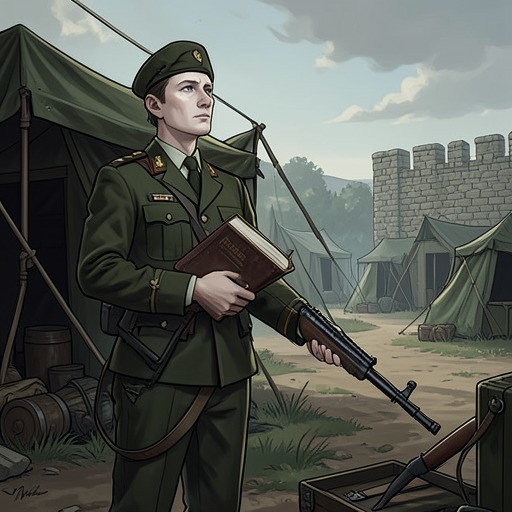
After graduating from Yale Medical School with a specialization in comparative anatomy, William Chester Minor applied to serve as a surgeon. The Union Army was short of medical personnel during the Civil War and accepted him for training at Knight Hospital in New Haven. He joined on 29 June 1863, four days before the Battle of Gettysburg. The timing places his enlistment at a major turning point in the war, though it does not establish what he experienced there or what effect the battle had on him.
Minor began as an acting assistant surgeon, a contracted rank shared by 5,500 men during the conflict. The book describes considerable variation in their qualifications and conduct; many left the army after the war, and few could expect promotion or a regular commission. Minor’s subsequent progress distinguished him from most of this group. He worked in the Union hospital system, including at L’Overture Hospital, which served many Black patients and formerly enslaved people who had escaped from the South, as well as at Alexandria General Hospital and Slough Hospital. His former military hospital in New Haven asked that he return because his work had been so good.
Surviving autopsy reports offer a record of that work. They are described as neatly written, with confident medical language and direct conclusions about causes of death. Most concern common and often fatal illnesses of the period, including lung cancer, typhoid, and pneumonia, for which Civil War medicine had limited treatments. A report from September 1866 records the severe injuries of a recruit struck by lightning while on sentry duty. By then, Minor was serving on Governors Island in New York, no longer as a contractor but as a commissioned captain and assistant surgeon in the U.S. Army.
Advancement and the limits of the record
Minor’s promotion followed hard work and scholarship, aided, the account says, by his Connecticut connections. His supporters did not recognize an emerging mental illness. Yale professor James Dana praised his abilities and supported his appointment; another academic described him as a skilled physician and scholar. Before his formal examination, Minor signed a declaration that he had no mental or physical infirmity that could interfere with effective service in any climate. His examiners approved him, and by mid-1866 he held a commission.
The surviving professional record gives detail about Minor’s competence, but the military evidence does not make his later illness’s cause certain. In 1868, after reportedly spending too long in the Florida sun, he developed severe headaches and vertigo and was sent under escort to New York for examination. On 3 September, a military medical report described him as suffering from monomania and classified him as delusional. The records mark a change in the Army’s assessment: earlier endorsements of his fitness gave way to formal evidence that he could no longer be relied on for duty.
By November, military doctors recommended that Minor be institutionalized. They described his condition as both suicidal and homicidal and said he was willing to enter an asylum. The medical record used the period’s diagnosis of monomania, while later accounts would apply other terms. In 1918, at St Elizabeths Hospital, a psychiatrist described Minor’s condition as dementia praecox of the paranoid form. That later diagnosis belongs to a different medical setting and vocabulary; it does not retrospectively prove what caused his illness or what the Army could have known when he served.
Medical retirement and its consequences
The following April, Minor’s commanders held a hearing to determine whether he should be placed on the Army Retired List. A board of senior officers heard doctors debate possible explanations for his decline. Some attributed a role to exposure to the Florida sun; others suggested that the sun had aggravated an existing condition or that war experience had contributed. The hearing preserved disagreement rather than resolving it.
The Army’s administrative finding was clearer than its account of causation. It declared Minor incapacitated by causes arising in the line of duty and retired him with immediate effect. That wording formally connected his disability to his service, without identifying a specific event as its source. The ruling also carried a material consequence: he retained his pay and pension, which continued for the rest of his life. The Army’s recognition of a service-related incapacity thus shaped his financial security after it had ended his military career.
The book considers several possible influences on Minor’s illness, including battlefield exposure, his later experiences, and a cruel punishment he had been ordered to inflict on an Irish soldier. It also emphasizes that these possibilities cannot be treated as a settled explanation. The Army board’s line-of-duty finding was an administrative judgment, not proof that any one of these proposed causes produced his condition. Keeping those claims distinct matters: the institution could determine that he was no longer fit to serve and provide a pension without establishing the medical origin of his illness.
Institutional significance
The U.S. Army’s role in Minor’s life is defined by a progression from recruitment to recognition, then from medical assessment to retirement. It first made use of his training during a personnel shortage; his hospital work and scholarship helped him rise from a contracted post to a captain’s commission. When his condition deteriorated, military doctors and commanders converted observations about his behavior and health into findings about fitness for duty, culminating in his removal from active service.
The surviving record also shows the limits of institutional knowledge. The Army documented Minor’s competence, symptoms, examinations, and retirement, yet the causes discussed at the hearing remained possibilities. The decision that his incapacity arose in the line of duty gave him a lasting pension, but it did not end uncertainty about the illness itself. In this account, the Army is therefore both a career-making institution and a system that could acknowledge the consequences of service without explaining them.